Speed is not the same thing as consequence
Many AI conversations become confused because they treat all work as if it should be delegated on the same basis. It is easy to ask whether AI can do a task. The more useful question is whether the task carries consequence that still needs human judgment.
That distinction matters because businesses do not mainly get hurt by raw activity. They get hurt when direction is set badly, when commitments are made too casually, when edge cases are mishandled, or when tradeoffs are made without enough context. In other words, the dangerous mistakes are usually not about language generation alone. They are about judgment under consequence.
What AI should carry more of
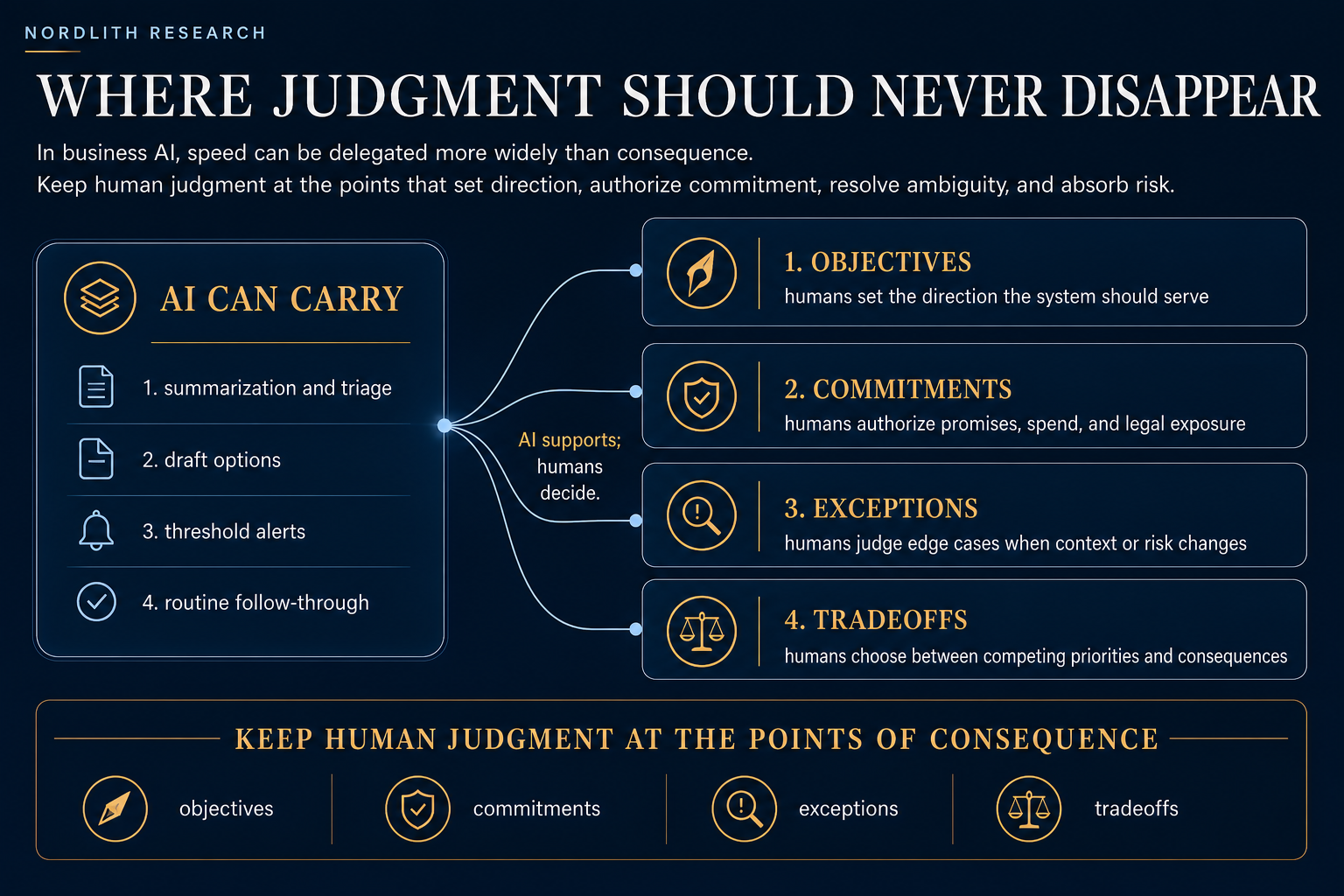
Used properly, AI can take a meaningful amount of weight off the operating layer. It can compress messy signal into a usable brief. It can draft options before a human chooses among them. It can watch thresholds, aging work, or exceptions that deserve attention. It can carry routine follow-through so that actions are less likely to disappear between a meeting and the next useful moment.
Those are real gains. They create leverage because they reduce friction without pretending the system has become the accountable principal. A serious implementation uses AI to make the business lighter to run, not to erase the need for decision ownership.
Where judgment should stay visibly human
Four areas deserve particular protection.
- Objectives: the business still needs people to define what matters, which outcomes take precedence, and what kind of result is actually worth pursuing. AI can help clarify options, but it should not quietly become the author of institutional intent.
- Commitments: promises to clients, approvals, spending decisions, and legally meaningful steps should stay under explicit human authority. These decisions create obligation. They are not just another workflow event.
- Exceptions: unusual cases are exactly where the operating environment stops behaving like the training example. When context changes, signals conflict, or risk rises unexpectedly, human judgment is what keeps the business from applying the right rule in the wrong situation.
- Tradeoffs: competing priorities, constrained capacity, and long-term consequences require more than fluent recommendation. They require accountable choice about what gets protected, delayed, or sacrificed.
Why this boundary is commercially important
Firms that blur this boundary often create a sophisticated-looking form of irresponsibility. The AI layer becomes visible enough to influence decisions but not accountable enough to own them. Leadership then inherits a strange burden: the system appears helpful, yet nobody is fully clear about where human authority is meant to harden into decision.
That ambiguity is expensive. It slows approvals, makes exception handling inconsistent, weakens client confidence, and creates avoidable reconstruction work after the fact. A system that sounds decisive but leaves the real decision-rights boundary vague is not reducing operational drag. It is relocating it.
Serious systems make the boundary legible
This is why the best business AI systems do not merely automate more. They make delegation boundaries legible. They show what the system can carry, what it can recommend, what it can route, and where it must stop for human judgment. That legibility is not a compliance afterthought. It is part of the operating design.
Once that boundary is explicit, the system becomes easier to trust. Teams know when AI is there to accelerate execution and when a person must still make the consequential call. Leaders know which parts of the business have become lighter and which parts still require direct judgment. Buyers can evaluate whether an AI proposal is strengthening governance or simply masking it.
A practical buyer test
When evaluating AI operators, agent systems, or automation-heavy proposals, serious buyers should ask four plain questions. Who still sets objectives? Who still authorizes commitments? Who handles exceptions? Who owns the tradeoffs when priorities collide?
If those answers are fuzzy, the system is probably not ready for serious use, however polished the demo may be. Good AI does not need to impersonate judgment to create value. It needs to preserve judgment where consequence concentrates and carry more of the surrounding load responsibly.
The stronger ambition
The mature goal is not “human out of the loop” by default. It is a better division of labour. Let AI carry the compression, preparation, monitoring, and continuity burden it is well suited to carry. Keep human judgment where direction, consequence, and accountability still matter most. That is the boundary that makes AI useful without making the business careless.