Weak follow-through is usually measured too narrowly
Most businesses know missed follow-through is bad. A task sits too long, a handoff slips, a decision is not actioned, or a client update arrives later than it should. The visible failure is easy to name. The harder part is seeing how much cost radiates outward from that missed moment.
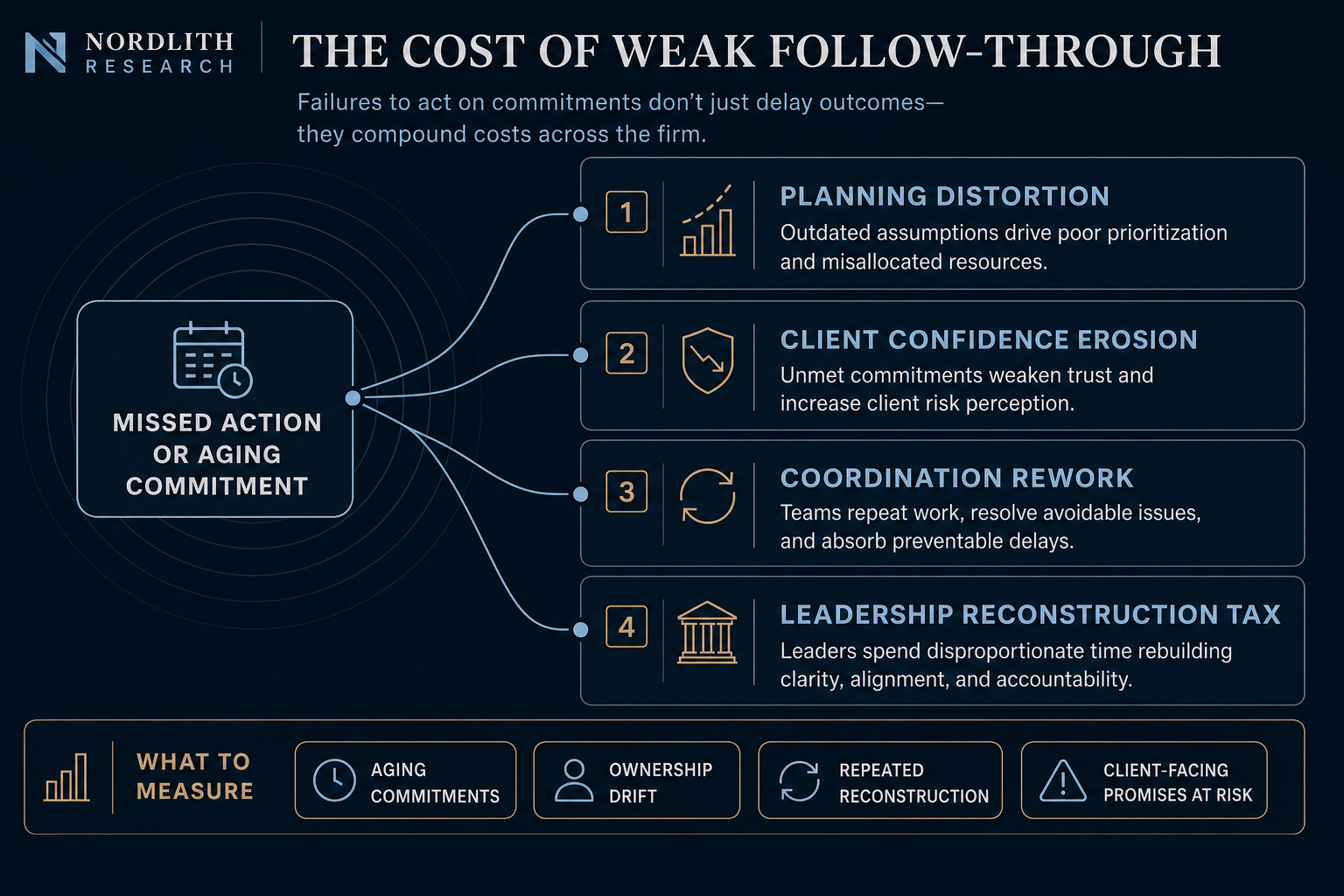
Weak follow-through rarely stays confined to one overdue item. It creates a chain of secondary work: clarification messages, repeated meetings, soft apologies, status-chasing, and fresh planning built on stale assumptions. By the time leaders notice the drag, the original missed action is often the smallest part of the bill.
The hidden cost is managerial reconstruction
One of the most expensive effects is not operational labour but leadership attention. When follow-through is weak, managers and founders spend time reconstructing state that should already be legible. What was decided? Who owns it? What is blocked? What is aging? What depends on it next? Those questions are expensive because they arrive in fragments and usually have to be answered under time pressure.
This is why weak follow-through feels heavier than the raw task count suggests. The business begins paying a reconstruction tax. Instead of using management time for direction, tradeoffs, or intervention, it spends that time rediscovering the truth of the workflow.
The commercial damage shows up in four places
Serious firms should think about follow-through cost in at least four categories:
- Planning distortion: future decisions are made against work that appears complete, underway, or harmlessly delayed when the real state is weaker.
- Client confidence erosion: externally, the business starts to look less exact than it believes itself to be, even when the underlying capability is strong.
- Coordination rework: teams repeat context, restate decisions, and reopen conversations that should already have moved into execution.
- Leadership residue: senior people keep carrying loose ends in working memory because the system is not carrying them reliably enough.
None of these costs show up cleanly in a simple overdue list. That is one reason the issue persists. Firms can feel the drag long before they can name it precisely.
Aging work is more dangerous than noisy work
Busy firms often focus on visible noise: message volume, calendar density, meeting count, dashboard clutter. Those are real problems, but aging work is usually more dangerous. Noise is irritating. Aging obligations are deceptive. They create the appearance of progress while quietly weakening delivery, accountability, and confidence.
Once a business accepts aging work as normal, it also starts accepting blurred ownership. A task that was clearly assigned on Monday becomes a shared concern by Thursday and an ambient worry by the following week. At that point nobody has truly lost the thread, but nobody is carrying it with enough force either. That is how avoidable work turns into strategic drag.
AI can either reduce the problem or accelerate it
AI does not solve follow-through by default. In badly designed environments it can intensify the problem by producing more summaries, more recommendations, more notifications, and more apparent movement without stronger ownership. The firm then gains activity without closure.
The useful role for AI is more disciplined. It should preserve context after decisions, make next actions explicit, surface aging commitments early, and route exceptions before they become leadership archaeology. In other words, the system should carry more of the continuity burden instead of generating another layer of residue.
What serious firms should audit
If weak follow-through is suspected, the right audit is not just “which tasks are late?” A better audit asks:
- Where does ownership become vague between now and later?
- Which commitments age without being visible to the right person soon enough?
- How often do leaders have to reconstruct status manually?
- Which meetings produce obligations that do not reappear cleanly in the operating layer?
- Which client-facing promises depend too heavily on individual memory rather than system support?
These questions reveal whether the business has a follow-through issue or a broader operating-visibility issue. In practice, the two are usually linked.
The practical standard is a lighter business
The real test is simple. Does the system leave the business lighter to run after decisions are made? Strong follow-through is not mainly about nagging people harder. It is about creating a cleaner path from decision to visible closure. The point is fewer open loops, less rediscovery, earlier escalation, and a lower memory burden on the people carrying the business.
That is also the commercial standard buyers should use when evaluating AI operators, automations, or agent systems. If the proposed layer does not reduce follow-through cost in a durable way, it is probably adding capability theatre instead of operational leverage.