Most AI disappointment is misdiagnosed
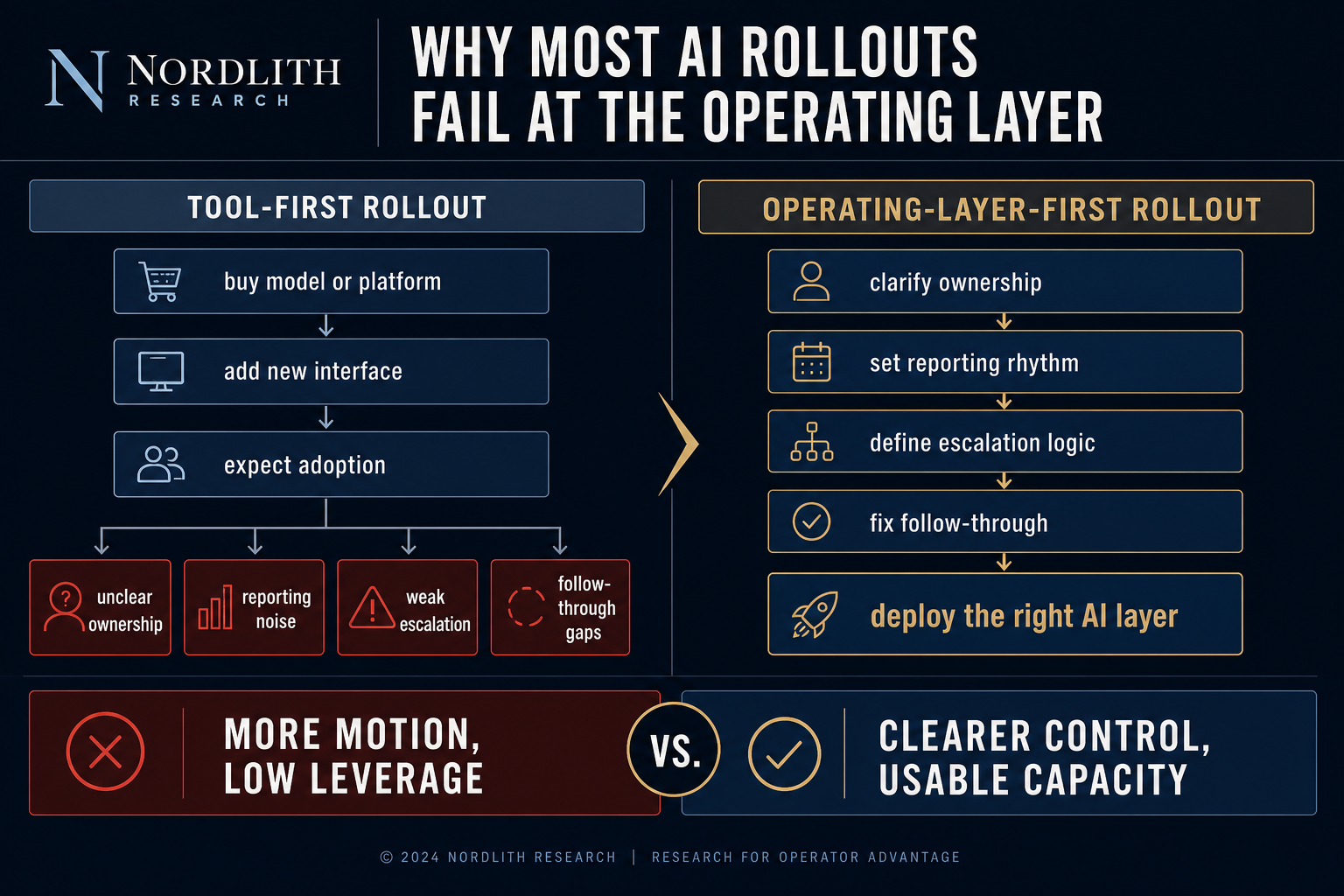
When an AI rollout underperforms, the postmortem usually blames adoption, prompting, model choice, or training. Those factors matter, but they are often downstream of the real failure. The business asked a new capability to land inside an operating environment that was already unclear about ownership, weak on reporting rhythm, inconsistent about escalation, and too dependent on human memory for follow-through.
In that environment, AI does not arrive as leverage. It arrives as another moving part. The result is familiar: teams say the tool is promising, leadership says the value is still hard to see, and nobody can cleanly explain why the rollout feels heavier than expected.
The tool layer is usually not the bottleneck
Many firms approach AI as a procurement event. They choose a model, a platform, or an automation product, then ask the organization to make better use of it. That can create isolated wins, but it rarely fixes the operating drag that made the search for AI attractive in the first place.
If decisions still sit too long without owners, if reporting still arrives as noise instead of signal, if handoffs still break between systems, and if leaders still have to reconstruct what matters from scattered updates, the rollout will struggle no matter how impressive the technology looks in a demo.
Where the operating layer usually breaks
The same failure pattern appears across industries. First, ownership is vague: the system can surface work, but no one has designed what should be explicitly carried, routed, or escalated. Second, reporting rhythm is weak: updates exist, but they arrive too late, too unevenly, or with too much interpretation burden. Third, follow-through is left to personal diligence: the business has activity, but not continuity.
AI can amplify all three problems. It can produce more output than the organization can govern, more notifications than leadership can absorb, and more apparent movement than the business can verify. That is why some rollouts feel busy without feeling useful.
What serious implementation looks like instead
The better sequence begins with the operating layer. Before buying another AI surface, a firm should ask four plain questions. Where does work stall? Where does leadership visibility fail? Where does ownership become ambiguous between now and later? Where does the business rely on people remembering what the system should already be carrying?
Those questions produce a more useful implementation plan than a features comparison does. They show whether the real need is a reporting layer, an automation layer, an operator layer, or a governed agent system. They also reveal whether the business is actually ready for acceleration or still needs clearer control.
AI should strengthen operating discipline, not replace it
The strongest rollouts make the business easier to run. They shorten the distance between signal and action. They reduce the number of loose ends leadership has to hold in working memory. They tighten review rhythm. They make escalation more deliberate. They improve visibility without flooding people with dashboards that nobody trusts.
That is a different goal from simply adding AI to existing workflows. It treats AI as execution infrastructure: a way to preserve context, route work, structure follow-through, and keep judgment where it belongs. Firms that adopt this posture usually see value sooner because the business problem and the technical intervention are finally aligned.
What buyers should ask before approving the next rollout
Serious buyers should ask whether the proposed system improves the operating layer or merely decorates it. Will ownership become clearer? Will reporting arrive in a better rhythm? Will stalled work surface earlier? Will escalation rules become more explicit? Will the business rely less on heroic human memory after meetings, decisions, and handoffs?
If the answer to those questions is vague, the rollout is probably still too tool-led. That does not mean the technology is weak. It means the implementation logic is incomplete.
The commercial conclusion
Most firms do not need more AI theatre. They need AI deployed where operational drag is already costing time, trust, and growth. That means treating rollout design as an operating-model decision before it becomes a software decision.
The practical payoff is substantial. When the operating layer is redesigned first, AI stops behaving like an experiment that must constantly re-justify itself. It starts behaving like usable business capacity: clearer reporting, stronger follow-through, better visibility, and less leadership residue.