Most firms still frame collaboration too loosely
Much of the market still talks about human-AI collaboration as if proximity were enough. Put a model near the team, let people prompt it, and call the result collaboration. That is adequate for experimentation. It is weak as an operating model. Businesses do not suffer mainly from lack of generated text. They suffer from work that becomes harder to see, harder to route, and harder to finish cleanly.
In that setting, collaboration should be judged less by how fluent the system appears and more by whether it reduces operational drag. Does it shorten the path from signal to action? Does it make ownership clearer? Does it surface the right decision to the right person at the right time? Those are collaboration questions in a serious business context.
The machine should carry structured load, not undefined authority
The most useful early role for AI is not to replace judgment. It is to carry load that is heavy, repetitive, or structurally annoying: capturing signals, drafting summaries, normalising inputs, surfacing likely actions, checking for omissions, and preparing work for decision. That is already valuable. It removes friction without pretending the system should own the whole consequence chain.
Problems begin when businesses hand the machine an ambiguous share of authority. If nobody can say where the system is allowed to act alone, where it must ask, and where it must stop, then collaboration becomes a risk-distribution scheme rather than a control improvement. The point is not to keep humans everywhere. The point is to keep human judgment where it matters most.
Good collaboration depends on routing and escalation
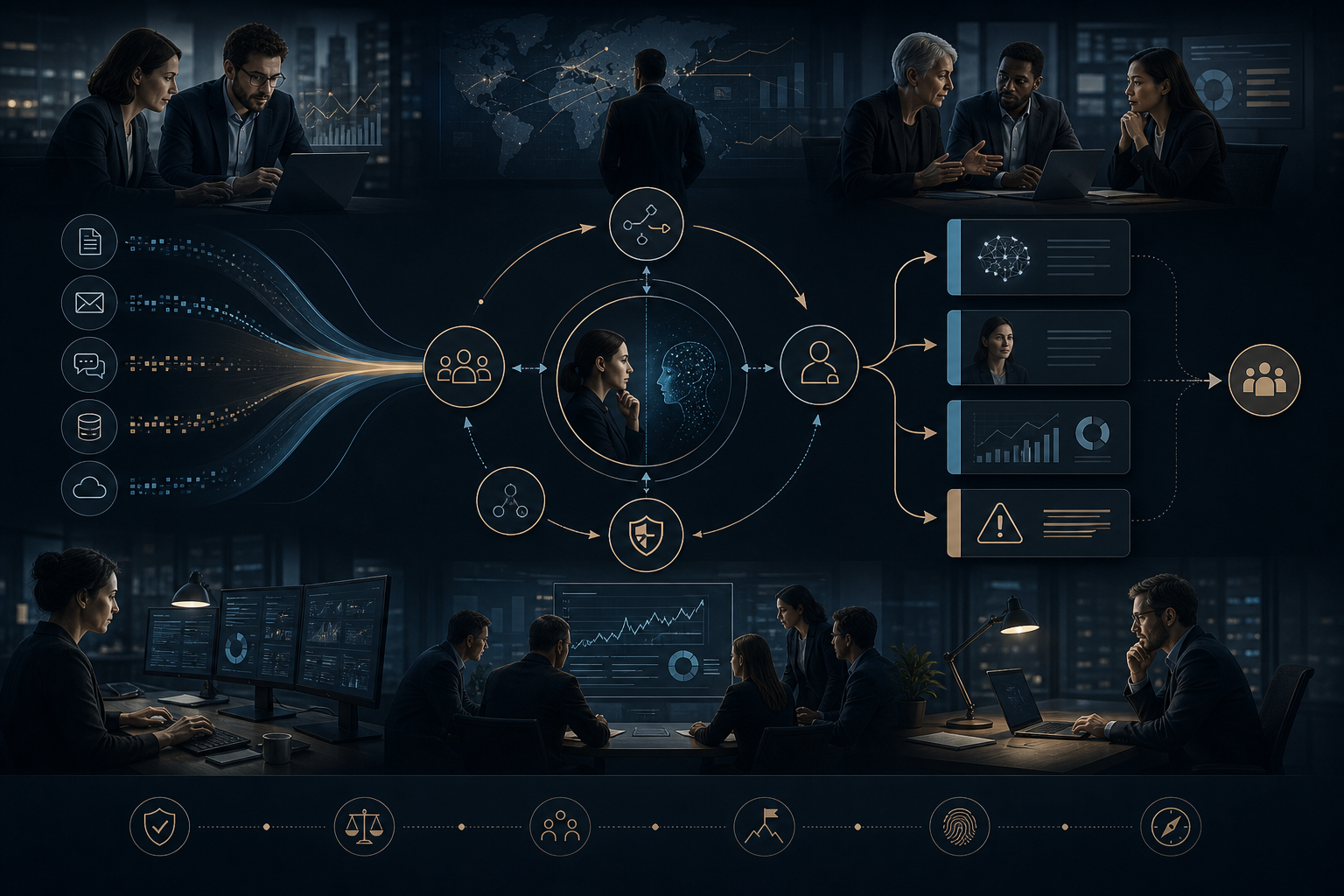
In practice, the strongest collaboration models look more like managed routing systems than magical partnerships. Some work should be handled directly by the system. Some should be prepared for a human owner. Some should be flagged because a threshold, contradiction, or uncertainty has been crossed. The quality of the collaboration depends on how cleanly those states are separated.
This is why escalation logic matters so much. A serious system should know when confidence is too low, when context is incomplete, when a task touches policy or reputation, or when a decision belongs to a named owner by design. Without that logic, the machine either acts too cautiously and becomes decorative, or acts too freely and creates avoidable risk.
Ownership must stay visible after the handoff
Many implementations focus on the moment of generation and ignore the rest of the operating chain. But most commercial failure happens after the draft, after the summary, after the recommendation. Work still needs an owner. Follow-through still needs a visible state. Exceptions still need a route back into the leadership view. If that is missing, the collaboration looks impressive locally while the wider business remains hard to govern.
Serious human-AI collaboration therefore requires explicit handoff design. Who accepts the output? Who confirms completion? What counts as done? What returns to the system as new memory, correction, or escalation signal? These are not administrative details. They are the difference between a helpful assistant layer and another source of residue.
The best measure is calmer control
When collaboration is designed well, one of the clearest effects is behavioural. Leadership spends less time reconstructing state from fragments. Operators spend less time repeating context. Meetings produce cleaner next actions. Important exceptions surface earlier. The business feels calmer not because less is happening, but because more of what is happening is visible, routed, and owned.
That is a better measure than headline capability. A collaboration model should leave the business easier to run. If it produces more activity but the same ambiguity, more output but the same chasing, or more apparent sophistication but weaker control, it has not matured into a serious operating layer.
What serious buyers should ask
Firms evaluating AI collaboration should ask practical questions before they ask for bigger demonstrations. What work is the system expected to carry without supervision? What work must always route to a human? What events trigger escalation? How is ownership preserved after handoff? How are corrections turned into better future behaviour? And what becomes easier for leadership to see because this model exists?
Those questions reveal whether the proposal is actually about collaboration or merely about generation. Serious human-AI collaboration does not remove management. It gives management a cleaner, more governable operating layer to work with.