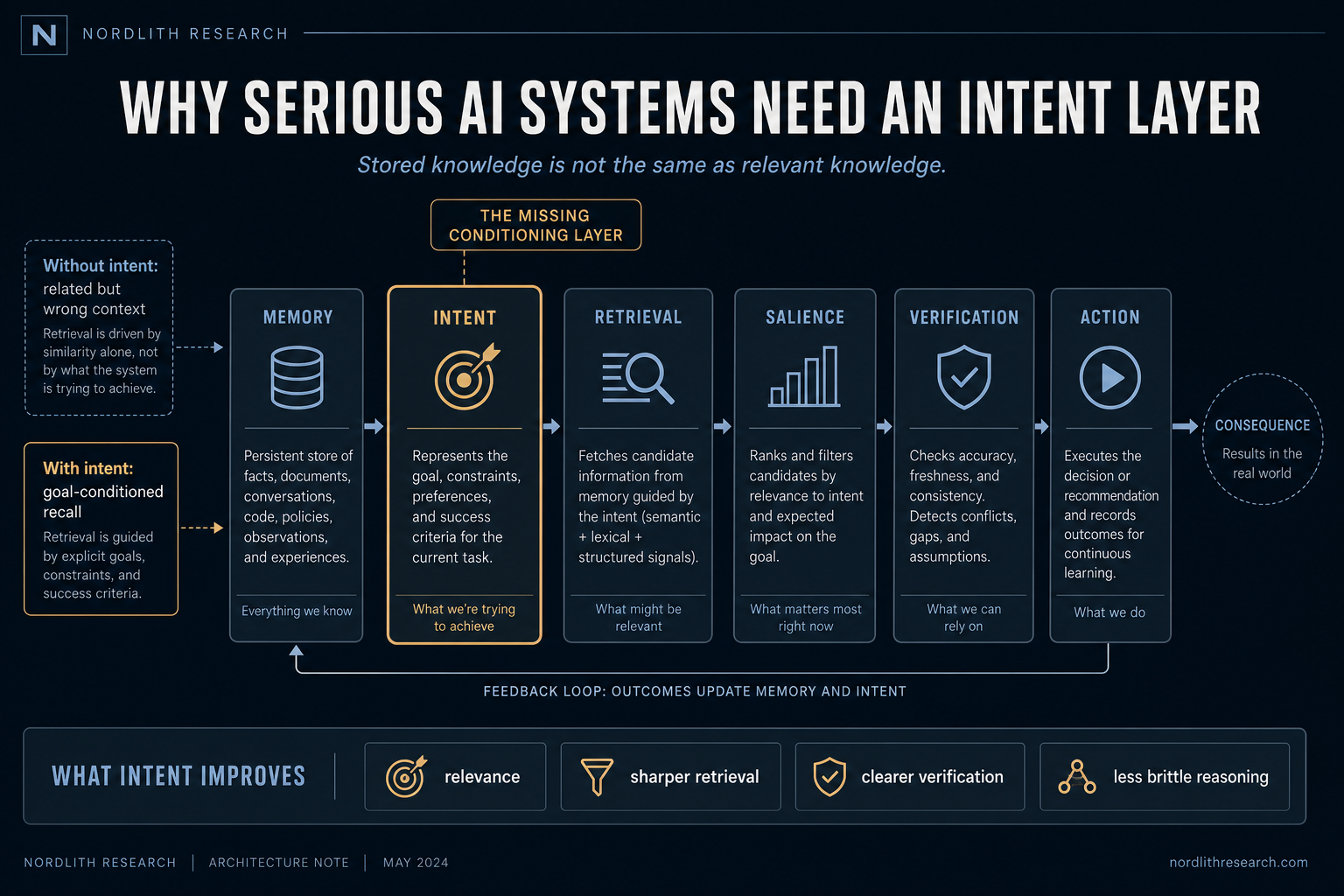
Stored knowledge is not the same thing as relevant knowledge
Many AI systems already have more context than they can use well. They can store long histories, retrieve semantically similar material, and surface related facts at impressive speed. Yet under real operating pressure they still fail in a familiar way: they retrieve something adjacent to the task instead of something fitted to the task.
That distinction matters because semantic relevance is not enough in long-horizon work. A system can retrieve something on the right topic and still be wrong for the job at hand. The failure is not always memory loss. Often it is goal mismatch.
This is where intent becomes architectural, not cosmetic
In many product conversations, intent is treated as a lightweight classification problem: label the utterance, route the response, move on. That is adequate for narrow dialogue systems. It is insufficient for systems expected to plan, retrieve, verify, compare, and sustain continuity over time.
In a more serious architecture, intent serves a different role. It helps the system infer what kind of move is underway, what constraints define success, and what sort of prior context should count as compatible with that move. In other words, it helps answer a more useful question than “what sounds related?” It asks, “related to what objective?”
The cleanest role for intent is between memory and consequence
There is a practical architectural split worth protecting. Memory answers what is stored. Salience answers what matters enough to change control flow or effort. Intent answers what is being attempted. If those roles are kept distinct, the system becomes easier to reason about.
The most effective initial posture is to place intent adjacent to memory rather than inside salience from the start. Let intent condition retrieval first. Then let salience use intent mismatch, ambiguity, or shift as stronger signals. That ordering keeps the design bounded and inspectable.
Why this matters commercially
For firms trying to use AI seriously, this is not a theoretical refinement. It affects whether the system can support real work. A leadership question, a continuity audit, a design comparison, and a verification task may all mention the same entities while requiring different context. Systems that retrieve by semantic closeness alone are more likely to confuse those modes. The result is noise, misplaced confidence, and slower decision-making.
An intent layer improves that by distinguishing the shape of the task: compare versus decide, collect versus verify, explain versus act, preserve versus publish. Once those differences are visible, retrieval can become sharper and downstream reasoning less brittle.
The strongest early proving slices are obvious
Not every domain is equally good for early implementation. The best first targets are places where the cost of ambiguity is already visible and where improvement is easy to feel. Reference recall is one. Project continuity is another. Verification routing is a third. In each case, the system already has information. The issue is selecting the right information for the current job.
This is also where many systems overbuild too early. A giant ontology is not the right first step. A bounded schema is. Thematic scope. Event or action type. Key entity types. Time horizon. Confidence. Enough structure to condition retrieval, not enough structure to become a bureaucracy.
What the intent layer really buys
If implemented well, intent does three valuable things. First, it reduces retrieval noise by filtering semantically similar but goal-incompatible context. Second, it gives salience a better basis for deciding when something is mismatched, ambiguous, or worth escalating. Third, it gives the maturation layer something worth reinforcing: not just what was recalled, but why that recall fit the active task.
That combination is important because serious AI systems do not improve only by storing more, nor only by ranking harder. They improve by learning which kinds of context are useful for which kinds of work.
The strategic conclusion
Intent should not be treated as just another metadata field bolted onto memory. It should be treated as a compact active ability for goal-conditioned context selection. That makes it a legitimate architectural lane: adjacent to memory, upstream of some salience decisions, and eventually part of the system's broader judgment machinery if the bounded trials prove worthwhile.
The firms that build this well will produce systems that look more coherent long before they look more intelligent. And in practice, coherence is usually the more valuable business trait.