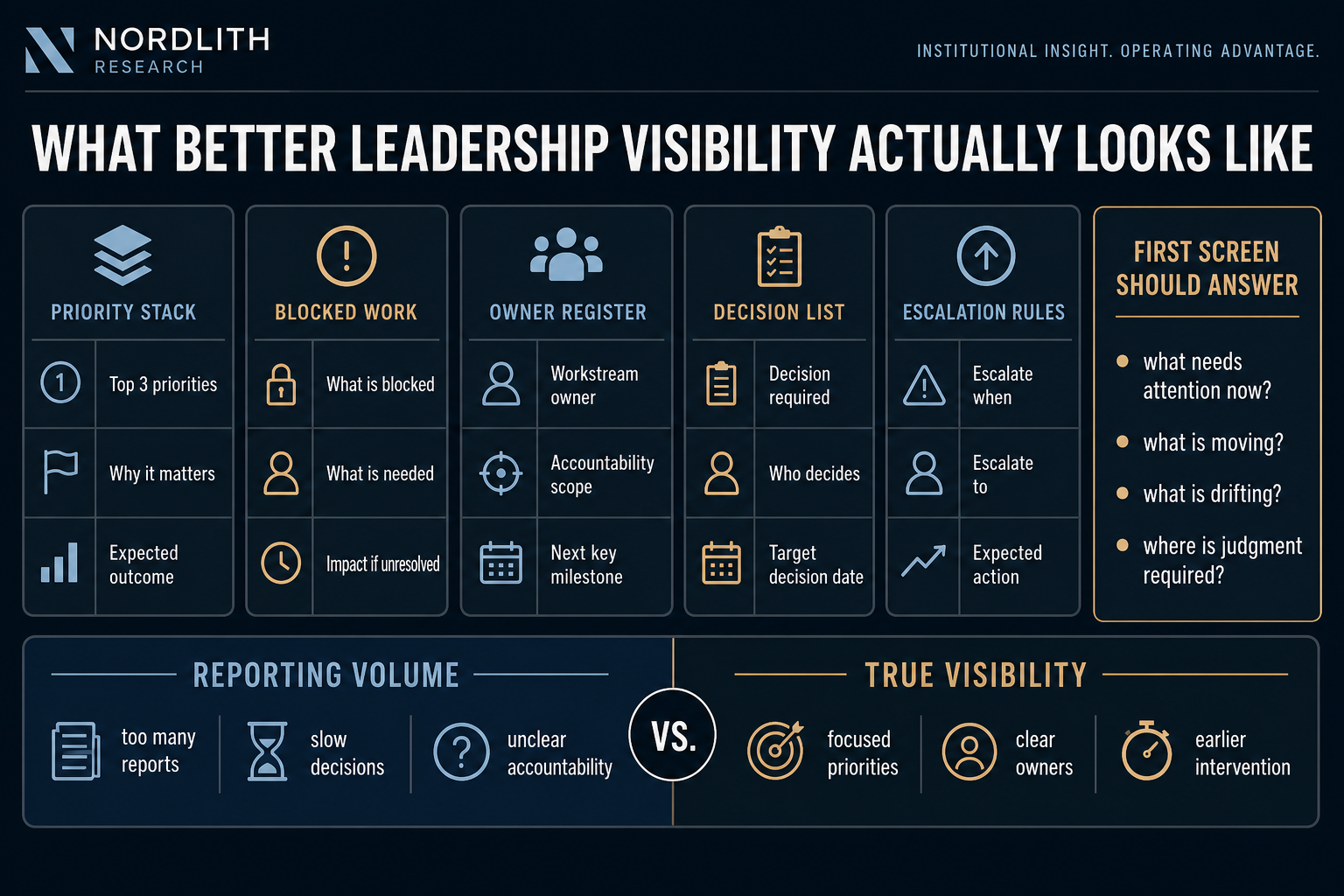
Visibility is not the same thing as volume
Many firms say they want better visibility when what they really have is a reporting problem. More updates arrive, more dashboards appear, and more information circulates, but leadership still does not know what matters most. Visibility is not achieved when the business produces more output. It is achieved when the important state of the business becomes easier to see without excavation.
That distinction matters because information overload often disguises control weakness. If leaders need to read everything to understand anything, the reporting layer is still doing too little filtering, shaping, and prioritisation.
The first screen should answer four questions
A useful leadership view should answer four questions quickly. What needs attention now? What is moving as expected? What is drifting without enough ownership? Where is judgment required? Those are not software questions. They are operating questions. The system exists to make those answers legible before leadership has to start chasing people for context.
In practice, this usually means a narrower and more disciplined surface than many firms expect: a small number of priority movements, explicit blocked work, visible aging or escalation thresholds, and a decision list that separates routine noise from matters that genuinely need senior judgment.
Good visibility makes ownership visible, not merely status
Status alone is cheap. A green marker beside a project tells leadership very little if no one can explain what changed, what is at risk, or who is responsible for the next movement. Better visibility makes ownership visible alongside status. It shows where work is aging, where responsibility is unclear, and where an apparent update is hiding unresolved dependency.
This is one reason many dashboards disappoint. They present motion without accountability. Leadership sees activity, but not always control. A serious operating surface should make it easy to tell whether the business is truly moving or merely narrating itself.
Reporting rhythm matters more than reporting volume
Leadership visibility also depends on cadence. A business that reports constantly but inconsistently often creates more uncertainty than a business with a firm weekly rhythm and a clear escalation path for exceptions. Better visibility comes from knowing when information will surface, in what shape, and what threshold turns an ordinary update into a leadership issue.
This is why reporting rhythm matters more than raw reporting volume. The goal is not permanent exposure to every signal. The goal is confidence that important signals will arrive on time, in a form that is usable, and with enough context to support action.
The right visibility should reduce leadership tax
When visibility improves, one of the first changes is not aesthetic. It is behavioural. Leaders spend less time chasing, interpreting, and reconstructing state from fragments. Review meetings become shorter and more decisive. Follow-through becomes easier to test. Escalations happen earlier, while they are still manageable.
That is the real measure. Better visibility should reduce leadership tax. If a new system produces richer screens but leaves the same level of ambiguity, residue, and chasing behind it, the business has added reporting theatre rather than operating control.
What serious firms should ask for
Firms evaluating AI, dashboards, or operating redesign should ask for something more concrete than “better visibility.” They should ask to see the priority stack, the blocked-work view, the owner register, the decision list, and the escalation logic. They should ask what appears weekly, what appears only when thresholds are crossed, and what remains in the human judgment layer by design.
That is where better visibility becomes real. Not when the interface looks impressive, but when leadership can see the business more clearly, intervene earlier, and carry less uncertainty into the next decision.